Most families are pretty good at managing the obvious things.
The mortgage gets paid. Bills are covered. Super contributions are made. Savings slowly build.
But there are a handful of important financial details that are easy to overlook — until you really need them.
So, here’s a simple financial checklist worth working through with your partner or family.
Do you have an emergency fund?
Unexpected expenses are part of life.
A broken-down car, major home repair, medical expense or temporary loss of income can put pressure on the household budget very quickly.
There’s no magic emergency fund number that works for everyone, but having money readily available can give your family valuable breathing room.
Start by working out your essential monthly expenses, then consider how many months you would feel comfortable having covered.
Do you know exactly what insurance you have?
Insurance is one of those things many people set up and then forget about.
But your circumstances can change significantly over time.
Ask yourself:
- Do I have enough life insurance?
- What would happen if I couldn't work?
- Do I have income protection?
- Would TPD or trauma cover be appropriate?
- Are the policies still suitable for my family?
- Are any policies duplicated or no longer necessary?
The goal isn't necessarily to have more insurance.
It's about having the right protection for your circumstances.
Have you checked your super beneficiaries?
Your super isn't always treated exactly like the rest of your assets when you die.
It's worth knowing who you've nominated as your beneficiaries and whether your nomination is still appropriate.
Life changes — relationships change, children grow up, and family circumstances can be very different from when you first joined your super fund.
It's a small detail that can be easy to overlook.
Is your will still up to date?
A will isn't just something to think about when you're older.
Marriage, separation, having children, buying a home, starting a business or significant changes in your finances can all be reasons to review your estate planning arrangements.
If you haven't looked at your will for years, it may be worth checking whether it still reflects what you want.
And remember, your will is only one part of an overall estate plan.
Does your partner know where everything is?
This one is surprisingly important.
If something happened to you tomorrow, would your partner know:
- Which banks you use?
- Where your super is held?
- What insurance you have?
- What debts you owe?
- Where important documents are kept?
- Who your accountant, financial planner or solicitor is?
- How to access important financial information?
You don't necessarily need to share every password.
But your family should have a way to find the information they'll need if you're suddenly unavailable.
Have you reviewed your debts?
Not all debt is necessarily bad, but it's worth knowing exactly what you're paying.
Check your:
- Home loan
- Credit cards
- Personal loans
- Car finance
- Buy-now-pay-later accounts
- Other ongoing commitments
Look at the interest rates, repayments and remaining balances.
You may find there are opportunities to simplify your finances or reduce the cost of your debt.
Are you still happy with your super?
Your super could become one of your biggest assets over your lifetime.
Yet many people rarely check what's happening inside their account.
Take a look at:
- Your current balance
- Investment option
- Fees
- Insurance
- Beneficiary nomination
- Whether you have multiple super accounts
Small differences over many years can have a meaningful impact on your eventual retirement position.
Are your investments still right for you?
Your investment strategy shouldn't necessarily stay the same forever.
Your goals, timeframe, income, debts and tolerance for investment ups and downs can all change.
A portfolio that was appropriate five years ago may not be the right fit today.
That doesn't mean you need to constantly change your investments.
Sometimes the best decision is to stay the course.
But it's worth knowing
why you're invested the way you are.
Do you know what you're actually spending?
You don't need to track every coffee to have a good understanding of your finances.
But you should have a reasonable idea of where your money is going each month.
Look at:
Income → essential expenses → lifestyle spending → saving → investing → debt repayments
Understanding your cash flow makes it much easier to make decisions about things like paying off the mortgage, investing more or increasing your super contributions.
Have you talked about your financial goals?
This might be the most important one.
Financial planning isn't just about accounts, investments and insurance.
What are you actually trying to achieve?
Maybe it's:
- Paying off the mortgage
- Travelling more
- Helping your kids
- Starting a business
- Buying an investment property
- Retiring early
- Working less
- Having more financial freedom
Your financial decisions make much more sense when they're connected to something you actually care about.
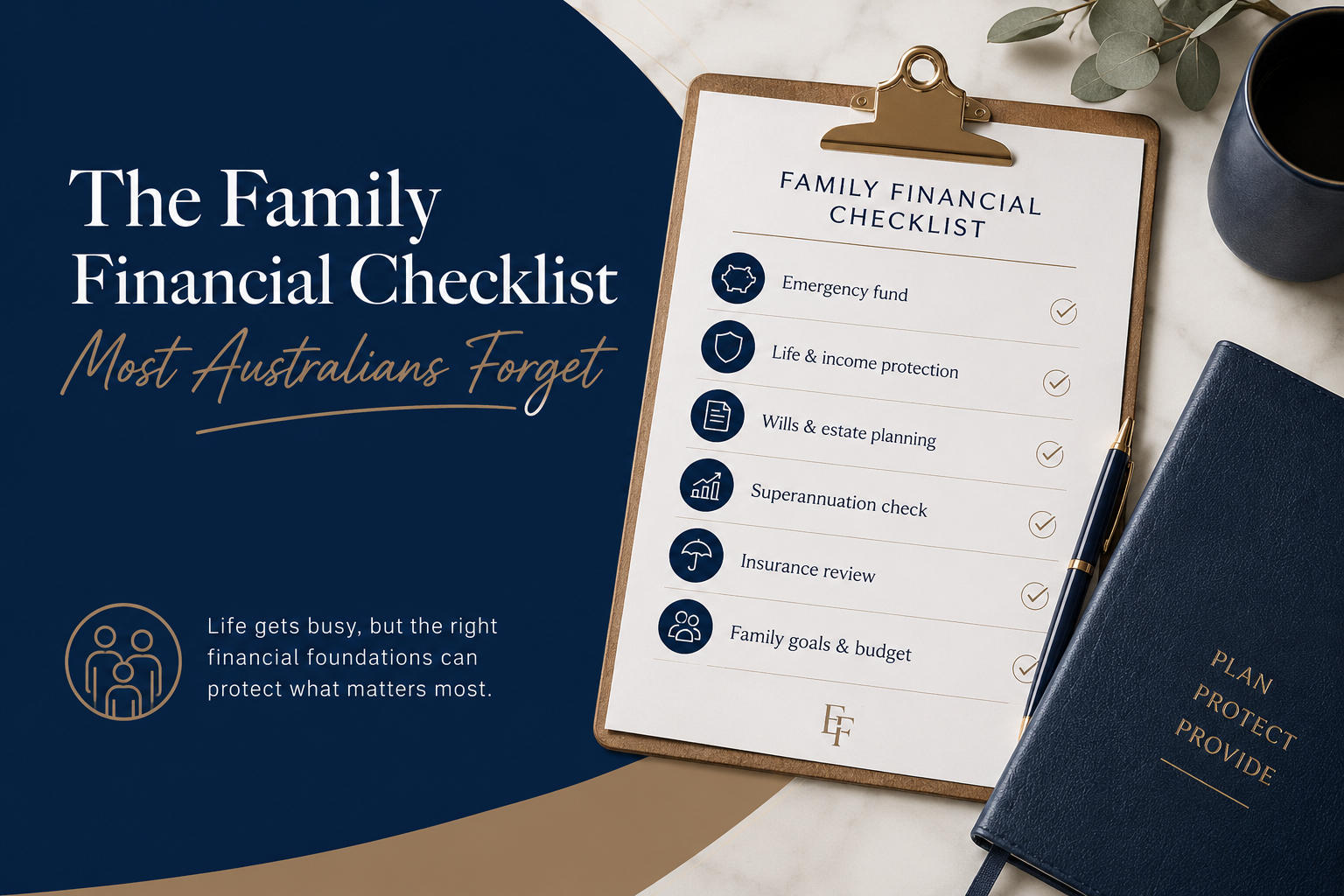
Your simple family financial checklist
If you want to keep it simple, start here:
☐ Emergency savings reviewed
☐ Insurance checked
☐ Super beneficiaries checked
☐ Will and estate plan reviewed
☐ Important financial information organised
☐ Debts reviewed
☐ Super checked
☐ Investments reviewed
☐ Household spending understood
☐ Financial goals discussed
You don't have to do everything in one afternoon.
Pick one or two items and work through them.
The important thing is not having a perfect financial plan.
It's making sure the important things
don't get forgotten.
A financial plan should change as your life changes
Your finances don't stay still.
You might have another child, change jobs, buy a home, pay off debt, receive an inheritance, start a business or get closer to retirement.
That's why reviewing your financial position from time to time can be so valuable.
At Elevate Financial Planning, we look at the bigger picture — not just your investments.
Because good financial planning is about making sure your money, protection and financial decisions continue to support the life you're building.
For personalised
financial services and advice, speak with your
Financial Advisor today at
Elevate Financial Planning
- Arlan Davine (Elevate Financial Planning)